







































































































































































10 Healthy Morning Habits to Boost Energy and Productivity
Author: RVLNSV PRASAD
Updated On: October 2026
About Us
Author Bio
Editorial Policy
Contact Us
Quick Answer
The best healthy morning habits are not about waking at an extreme hour or following a complicated routine. A useful morning routine can include getting up at a reasonably consistent time, exposing yourself to natural light, drinking fluids according to your needs, moving your body, eating a nutritious breakfast if it suits you, protecting your attention from unnecessary digital distractions, and deciding what matters most that day.
The bigger goal is to create a morning that supports the habits you want to maintain throughout the day.
Research increasingly shows that regular sleep timing, appropriate light exposure, physical activity, and consistent behaviors are more meaningful for health than following a perfect “5 AM routine.” Your routine also needs to fit your work schedule, family responsibilities, health conditions, culture, and personal preferences.
Introduction: Your Morning Does Not Have to Be Perfect to Be Healthy
A morning can begin in very different ways.
One person wakes up, opens the curtains, drinks water, takes a short walk, and starts work calmly. Another wakes up late because of a difficult night, helps children get ready, skips breakfast, and rushes out of the house.
Neither person needs the same routine.
This is something many morning-routine articles overlook.
There is no universal sequence that guarantees energy, productivity, weight control, or happiness. Your morning should support your life rather than become another source of pressure.
The science is also more nuanced than the popular idea that every person needs an early wake-up, a large glass of lemon water, a “perfect” breakfast, meditation, exercise, journaling, and several other activities before 8 a.m.
Your circadian system responds strongly to the light-dark cycle, and morning light can help synchronize the biological clock. Regular sleep and wake times are also important components of healthy sleep. The National Institutes of Health explains how light exposure interacts with the body’s circadian system and sleep-wake cycle.
That gives us a better starting point.
Instead of asking, “What is the perfect morning routine?” ask:
“What small actions make the rest of my day healthier and easier?”
That question is more realistic, and it is easier to turn into lasting behavior.
What Are Healthy Morning Habits?
Healthy morning habits are repeatable actions that support physical health, mental well-being, energy, attention, sleep timing, movement, nutrition, or daily organization.
They do not have to be performed immediately after opening your eyes.
They also do not need to take an hour.
A healthy morning routine might take 10 minutes on a busy weekday and 45 minutes on a relaxed weekend. The important part is whether the routine is realistic enough to repeat.
A 2024 systematic review and meta-analysis of health-behavior habit formation found substantial individual variation in how long habits take to become automatic. The researchers reported that the commonly repeated “21-day” idea does not represent the complexity of habit formation; the time required varies considerably between people and behaviors. The full review is available through PubMed.
This is useful because it removes unnecessary pressure.
You do not have to perform a routine perfectly for 21 days before it “counts”; instead, you are gradually building a pattern that can become easier to maintain over time.
1. Wake Up at a Consistent Time That Fits Your Life
One of the most useful morning habits is surprisingly simple: try to keep your wake time reasonably consistent.
This does not mean you must wake at exactly 5:00 a.m.
If your work begins at 9:00 a.m., your appropriate wake time may be completely different from someone who works a night shift.
The goal is to create a predictable sleep-wake pattern that allows you to get enough sleep.
For most adults, the CDC recommends at least seven hours of sleep per night, although individual needs vary. The CDC’s sleep guidance also emphasizes the importance of adequate sleep for physical and emotional health.
A 2025 systematic review found moderate-certainty evidence linking greater irregularity in sleep timing with several adverse health outcomes, although the researchers also noted limitations in the available evidence. See the systematic review on sleep regularity in PubMed.
A practical approach
Instead of forcing yourself to wake extremely early, choose a wake time that allows enough sleep and is compatible with your responsibilities.
If your schedule changes frequently, aim for greater consistency where possible rather than perfection.
People-first tip: If you slept poorly one night, do not turn the next morning into a punishment. Recover your routine gradually.
2. Get Natural Light Early in the Day
Morning light is one of the most biologically meaningful parts of a healthy morning routine.
Your circadian clock receives information from environmental light. Light entering the eyes helps the brain distinguish daytime from nighttime and influences the timing of hormones involved in sleep and wakefulness.
You do not need to stare directly at the sun.
Instead, open curtains, sit near a bright window, step onto a balcony, or take a short outdoor walk when practical.
Morning outdoor light can be especially useful because daylight is generally much brighter than typical indoor lighting.
A simple “light before scrolling” experiment
Before checking social media, spend a few minutes near natural daylight.
This has another advantage: it creates a natural pause before digital information begins filling your attention.
Safety note: Never look directly at the sun. People with certain eye conditions or those taking photosensitizing medicines should follow their healthcare professional’s advice.
3. Drink Fluids Without Turning Hydration Into a Rule
You lose water during normal breathing, sweating, and urination while sleeping, so drinking fluids in the morning can be a sensible part of your routine.
However, you do not need to force a huge amount of water immediately after waking.
There is also no strong reason to believe that adding lemon automatically “detoxes” your body or dramatically increases metabolism.
Plain water is perfectly adequate for most people.
Your total fluid needs depend on factors such as climate, activity, food intake, body size, and health conditions. Someone exercising outdoors in hot weather may need considerably more fluid than someone spending a cool morning indoors.
The practical hydration cue
Keep a reusable water bottle where you can see it.
Drink according to thirst and your individual needs, and pay attention to situations that increase fluid requirements.
This is more sustainable than setting an arbitrary rule such as “everyone must drink one liter immediately after waking.”
People with kidney, heart, or other conditions that require fluid restriction should follow individualized medical advice.
4. Move Your Body Before the Day Becomes Busy
You do not need to complete a hard workout before breakfast to benefit from morning movement.
Five or ten minutes of walking, mobility exercises, stretching, household activity, yoga, or light exercise can be a practical way to start moving.
The broader evidence for physical activity is strong. The World Health Organization recommends regular physical activity for adults and notes benefits for cardiovascular health, metabolic health, mental health, and overall well-being.
WHO recommends adults accumulate 150–300 minutes of moderate-intensity aerobic activity per week, or an equivalent amount of vigorous activity, along with muscle-strengthening activity on at least two days each week. These are weekly targets, so you do not have to complete them in the morning. WHO physical activity guidelines.
The overlooked morning movement strategy
If a full workout feels impossible, use a movement starter.
Try:
- 2 minutes of walking
- 1 minute of shoulder and upper-back mobility
- 1 minute of gentle squats or sit-to-stands
- 1 minute of walking again
The goal is not to replace a complete exercise session.
It is to make movement easier to start.
Recent research is also exploring the cognitive effects of breaking up prolonged sitting. A 2024 systematic review and meta-analysis found that interrupting prolonged sedentary time with physical activity can produce acute improvements in cognitive function, although the evidence and effects vary by outcome. Read the research in PubMed.
5. Do Not Assume You Must Eat Breakfast
Breakfast is one area where popular advice often becomes too absolute.
Some people feel better after eating in the morning. Others are not hungry immediately after waking.
There is no universal breakfast that everyone must eat.
What matters more is your overall dietary pattern, nutritional adequacy, energy needs, medical situation, and how your eating schedule affects you.
Research on breakfast is also complicated. A randomized-trial meta-analysis found that breakfast skipping did not automatically produce the negative weight effects often claimed in popular advice, while observational research has found associations between breakfast skipping and health outcomes. These findings cannot simply be interpreted as “breakfast is always good” or “breakfast is always bad.” Randomized-trial evidence on breakfast skipping and a 2024 prospective-cohort meta-analysis illustrate why the subject needs nuance.
If you eat breakfast
Build it around foods that help you meet your nutritional needs.
A practical combination might include:
| Food group | Examples |
|---|---|
| Protein | Eggs, yogurt, dal, paneer, tofu |
| Fiber-rich carbohydrates | Oats, whole-grain roti, whole-grain bread |
| Fruit | Apple, banana, berries, guava |
| Healthy fats | Nuts, seeds, peanut butter |
| Vegetables | Tomato, spinach, cucumber, other vegetables |
For Indian households, breakfast does not have to look like a Western “fitness breakfast.” Idli with sambar, vegetable poha, dosa with a protein-rich accompaniment, dal-based dishes, eggs with vegetables, or other balanced traditional meals can fit into a healthy dietary pattern.
The better question is
“Does this meal help me meet my nutritional needs and fit my day?”
6. Delay Unnecessary Digital Noise
One of the most practical morning habits is also one of the easiest to ignore.
The first few minutes after waking can become a flood of notifications, advertisements, messages, news headlines, work requests, and social media posts.
You may not notice the effect immediately, but you have allowed other people’s priorities to enter your day before deciding what matters to you.
This does not mean smartphones are inherently unhealthy.
It means timing and intentionality matter.
Try the “first task before first feed” rule.
Before opening social media, complete one intentional action.
It could be:
- Opening the curtains
- Drinking water
- Walking outside
- Making your bed
- Preparing breakfast
- Reviewing your day’s priority
- Spending a few minutes with family
Then check your phone.
This is not a medical treatment. It is a behavioral strategy that creates a small boundary around your attention.
7. Choose One Important Task Before Creating a Long To-Do List
Productivity is not the same as filling a page with tasks.
A long list can create the feeling that you are already behind before the day begins.
Instead, identify one task that would make the day meaningfully better if completed.
Then choose two secondary tasks.
For example:
- Priority 1: Finish the most important work project.
- Priority 2: Walk for 20 minutes.
- Priority 3: Prepare tomorrow’s lunch.
This method is particularly useful for people who become overwhelmed by large task lists.
It also connects your morning routine with your real life.
The purpose of planning is not to control every minute.
It is to reduce unnecessary decision-making.
8. Use a Two-Minute Breathing or Mindfulness Pause
You do not need to meditate for 30 minutes to create a calmer transition into the day.
Two or three minutes of slow breathing, mindfulness, prayer, quiet sitting, or another personally meaningful practice may be enough to create a deliberate pause.
The evidence for mindfulness-based interventions is broader than a single morning breathing exercise, so it would be inaccurate to claim that two minutes will treat anxiety or depression.
However, recent systematic-review evidence continues to investigate mindfulness interventions for psychological outcomes, including stress, anxiety, and depression. See a 2026 systematic review and meta-analysis on PubMed.
Try this simple practice
Sit comfortably.
Take a normal breath in.
Allow the exhale to become slower and more relaxed.
Repeat for two minutes while noticing your breathing without trying to make every thought disappear.
If breathing exercises make you dizzy or uncomfortable, stop and return to normal breathing.
9. Use a Small Gratitude or “Good Thing.” Practice
Gratitude is not a substitute for treatment, and you do not have to pretend that everything is positive.
But deliberately noticing something meaningful can be a useful psychological practice for some people.
A systematic review and meta-analysis of gratitude interventions involving randomized trials found improvements in gratitude, mental health, and some emotional outcomes, although effects varied across studies and gratitude should not be presented as a cure for mental illness. See the systematic review and meta-analysis.
You can keep the practice extremely simple.
Write one sentence:
“One thing I appreciate today is ______.”
It could be your health, family, a friend, a quiet morning, a useful opportunity, or something as ordinary as having time for breakfast.
A more practical variation
Instead of only writing what you are grateful for, write:
“One thing I appreciate + one action I can take today.”
For example:
“I appreciate having enough energy to walk. I will take a 15-minute walk after lunch.”
This connects positive reflection with behavior.
10. Create a Morning Environment That Makes Healthy Choices Easier
This is one of the most overlooked healthy morning habits.
Your environment can either support your intentions or constantly fight them.
- If your walking shoes are hidden in a cupboard, you are less likely to remember them.
- If your phone is beside your pillow, checking it becomes effortless.
- If your breakfast ingredients are difficult to prepare, you may choose whatever is fastest.
Instead of relying entirely on motivation, redesign the environment.
The night-before advantage
Prepare one thing before going to bed:
- Put walking shoes near the door.
- Fill your water bottle.
- Keep breakfast ingredients ready.
- Place your work notebook on the desk.
- Charge your phone away from the bed.
- Prepare clothes for the morning.
This creates a low-friction morning.
The idea is simple:
Make the healthy action visible and easy.
Research on habit formation supports the importance of repetition, timing, and contextual cues, while also showing that habit development varies substantially among individuals. 2024 systematic review and meta-analysis.
The 15-Minute Morning Routine for Busy People
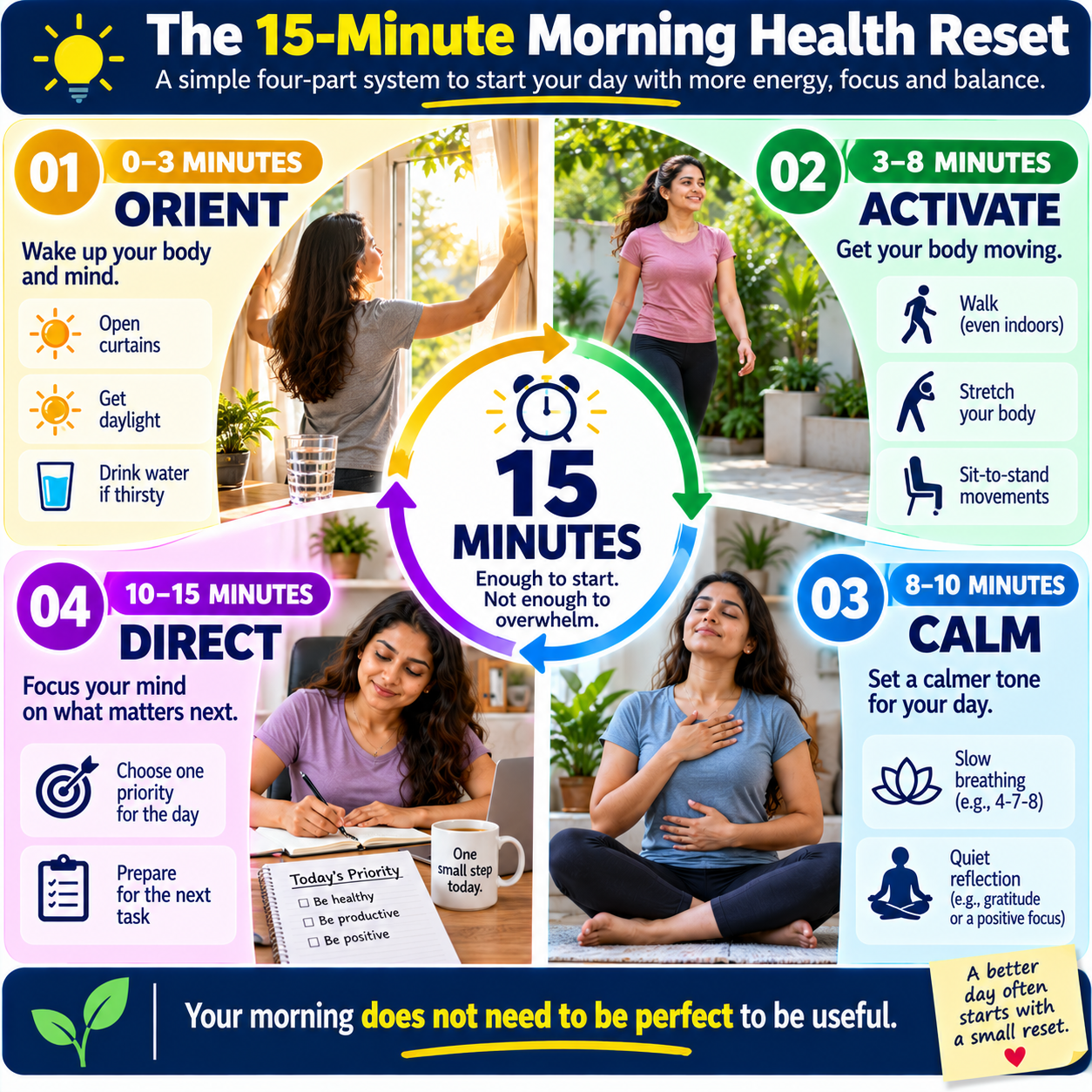
You do not need an hour-long morning ritual.
Try this:
| Time | Habit |
|---|---|
| 0–3 minutes | Wake up, open curtains, and drink fluids if thirsty. |
| 3–8 minutes | Walk or perform gentle movement. |
| 8–10 minutes | Slow breathing or quiet reflection |
| 10–12 minutes | Identify the day’s main priority. |
| 12–15 minutes | Prepare for breakfast/work/family responsibilities. |
That is enough.
If you have more time, extend the movement or prepare a nutritious meal.
If you have less time, use the smallest version that works.
A Better Morning Routine for Indian Households
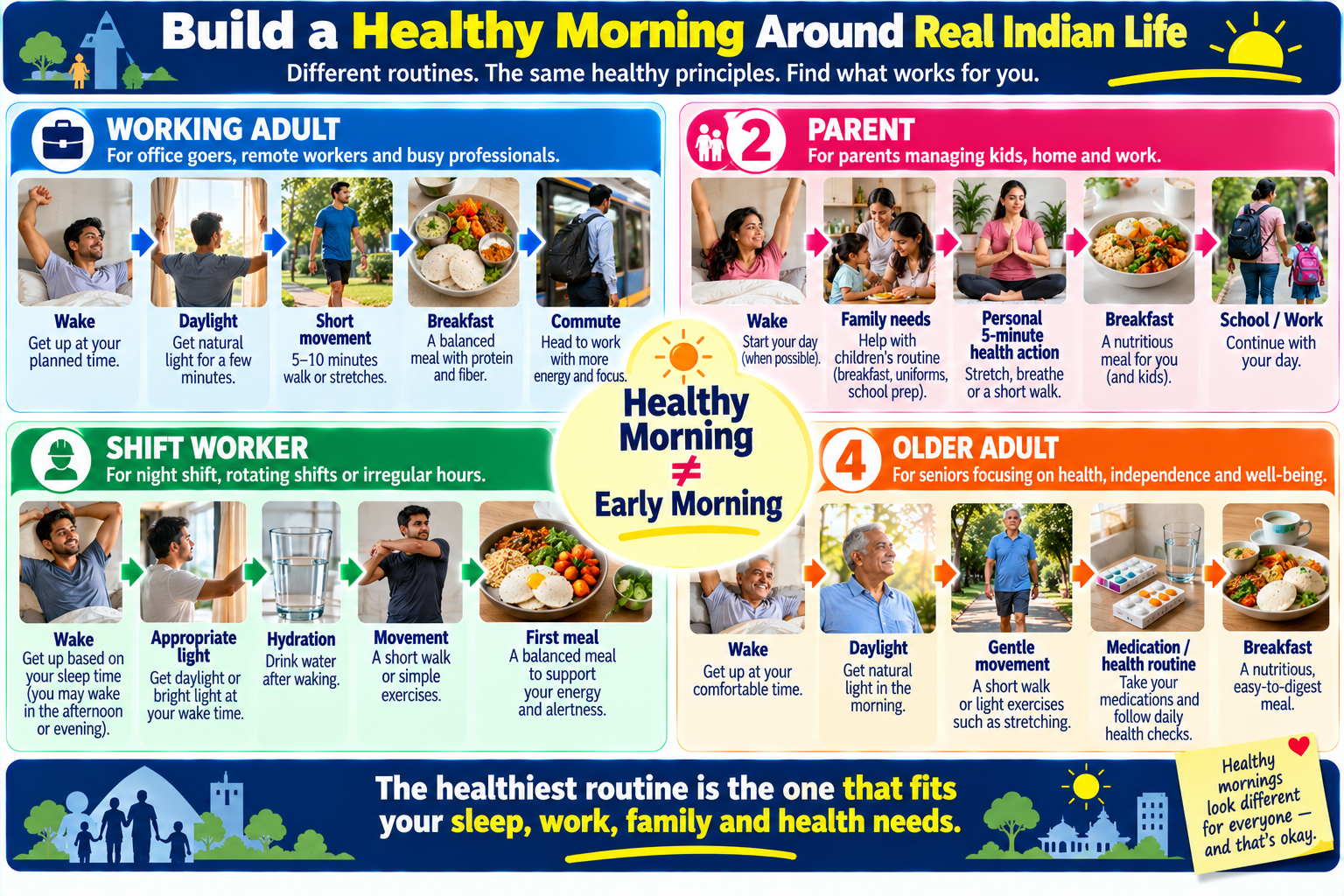
A useful routine should fit the way people actually live.
For many Indian families, mornings involve cooking, children, commuting, household responsibilities, prayer, work preparation, and sometimes caring for older family members.
That means a rigid Western-style morning routine may be unrealistic.
A more practical sequence could be
Wake → natural light → water if needed → household movement → breakfast preparation → one personal health action → daily priority
Your routine can happen around family responsibilities rather than pretending those responsibilities do not exist.
This is an important people-first principle:
A healthy routine should fit your life instead of forcing your life to fit the routine.
The Morning Habits That Matter Most for Different Goals
| Your goal | Morning habit to prioritize |
|---|---|
| Better sleep schedule | Consistent wake time + morning light |
| More daily movement | Short walk or movement starter |
| Better productivity | One priority before digital distractions |
| Healthier eating | Prepare a balanced meal or food option. |
| Less morning stress | Two-minute breathing or quiet time |
| Better routine consistency | Prepare the environment the night before |
| More energy | Adequate sleep + light + movement |
| Weight management | Overall eating pattern + regular activity rather than a “magic” morning habit |
Notice that no single habit appears as the solution to every goal.
That is intentional.
Latest Research: What We Are Learning About Morning Health
The newer evidence is moving away from the idea of a “perfect morning routine.”
Instead, researchers are examining how several systems interact.
1. Circadian timing matters.
Light is a major environmental signal for the circadian system. The timing of light exposure can influence sleep-wake timing, which is why morning daylight and reduced bright light at night are often discussed in sleep health. NHLBI explanation of circadian rhythm and light.
2. Sleep regularity deserves more attention.
Getting enough sleep is important, but researchers are increasingly examining when people sleep and how consistent those times are.
A recent systematic review identified associations between irregular sleep timing and several health outcomes, although researchers emphasized that evidence quality and measurement methods vary. PubMed review of sleep regularity.
This suggests that your morning routine cannot completely compensate for chronically poor sleep.
3. Short movement breaks are gaining attention.
You do not have to think only in terms of “exercise sessions.”
Breaking up prolonged sitting with movement is an increasingly studied strategy. A 2024 meta-analysis of randomized trials found acute cognitive benefits when prolonged sedentary time was interrupted by physical activity. Research published in PubMed.
This creates a useful practical lesson:
Morning movement is valuable, but so is movement later in the day.
4. Habit formation is more individual than popular advice suggests
The popular claim that every habit takes exactly 21 days is not supported by modern evidence.
A 2024 systematic review found substantial variation in habit-formation time and highlighted the importance of repetition, timing, self-selected behaviors, and contextual factors. PubMed evidence on habit formation.
Therefore, if your routine still feels unnatural after three weeks, you have not failed.
You may simply need more repetition.
Three Unique Morning Strategies Most Routine Articles Miss
The “minimum viable morning”
Create the smallest routine you can complete even on a bad day.
For example:
Open curtains + drink water if thirsty + walk for two minutes.
That is your minimum.
On better days, you can expand it.
This protects consistency when life becomes difficult.
The “decision-before-distraction” rule
Make one meaningful decision before consuming information.
For example:
“Today my most important health action is a 20-minute walk.”
Only afterward do you open social media or work messages.
This turns your morning from a reactive period into a deliberate one.
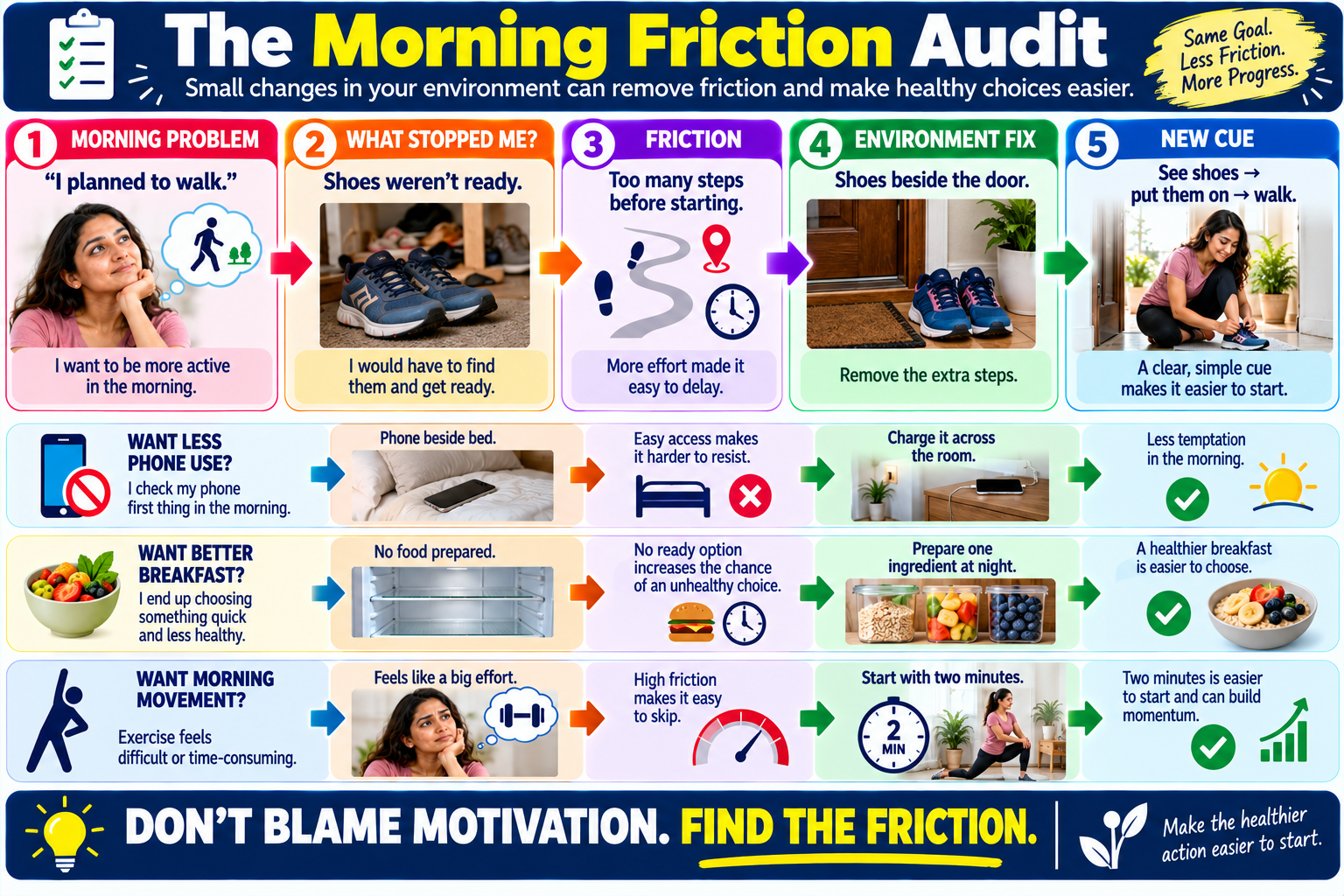
The “friction audit”
Once a week, ask:
“What made my healthy habit difficult this week?”
- Maybe your shoes were difficult to find.
- Maybe breakfast preparation took too long.
- Maybe you slept too late.
- Maybe your phone distracted you.
Fix the obstacle rather than blaming yourself.
This is a much more sustainable approach to behavior change.
Common Morning Routine Mistakes
Waking up extremely early despite inadequate sleep
Earlier is not automatically healthier.
If waking at 5 a.m. means sleeping only five or six hours, you may be sacrificing something more important.
Trying to copy someone else’s routine
A professional athlete, entrepreneur, influencer, parent, student, and shift worker may need completely different mornings.
Treating lemon water as a detox treatment
Lemon can add flavor and vitamin C, but it does not replace the body’s normal liver and kidney processes.
Believing breakfast is mandatory for everyone
Breakfast can be nutritious and useful, but individual eating patterns differ.
Exercising intensely without considering your body
A difficult workout is not necessary every morning.
Checking the phone immediately
You may unintentionally surrender the first part of your day to notifications.
Creating a 15-step routine
A routine that takes two hours may look impressive online but may be impossible to maintain in real life.
Giving up after one disrupted morning
Missing a habit once does not erase the routine.
Return at the next opportunity.
How Long Does It Take to See Results?
There is no universal timeline.
Some effects may be noticed quickly.
For example, a short walk may make you feel more alert in the moment, while better sleep timing may require repeated consistency.
Other benefits, such as improvements in fitness, weight management, or long-term health, require sustained behavior over much longer periods.
Habit formation itself varies considerably between individuals. The 2024 review discussed earlier found substantial variation, with some behaviors taking much longer than the popular 21-day claim suggests. Review of habit formation research.
Therefore, judge your morning routine by whether it is becoming easier to repeat, rather than expecting dramatic results after a few days.
A Simple 7-Day Healthy Morning Habits Challenge
Day 1
Open the curtains and get natural daylight.
Day 2
Add five minutes of walking or gentle movement.
Day 3
Choose one important task before checking social media.
Day 4
Prepare one healthy choice the night before.
Day 5
Try two minutes of slow breathing or quiet reflection.
Day 6
Notice one thing you appreciate.
Day 7
Review the week and keep only the habits that genuinely helped.
This final step matters.
You do not have to keep every habit; instead, your goal is to build your own morning routine around the habits that work best for you.
Key Takeaways
- Healthy morning habits do not require waking extremely early.
- Adequate sleep should come before an impressive wake-up time.
- Morning natural light can help support the circadian sleep-wake system.
- Regular physical activity matters more than whether you exercise at a particular hour.
- A short movement session can be a useful starting point.
- Breakfast is not universally mandatory; nutritional needs and preferences differ.
- Limiting unnecessary digital stimulation can create a calmer start.
- A two-minute breathing or mindfulness practice can provide a deliberate pause.
- Gratitude practices may support psychological well-being, but they are not a treatment for mental illness.
- Preparing your environment can make healthy behaviors easier to repeat.
- The best morning routine is the one you can realistically maintain.
- Missing one morning does not mean you have failed.
Frequently Asked Questions
1. What is the healthiest morning habit?
There is no single healthiest morning habit for everyone. Adequate sleep, appropriate morning light, regular physical activity, nutritious eating when appropriate, and a consistent routine all contribute to a healthy start.
2. Is waking up at 5 a.m. healthier?
Not necessarily. Waking at 5 a.m. is only useful if it fits your schedule and allows adequate sleep. Sleep duration and quality remain important.
3. Should I drink water immediately after waking?
You can drink water when you are thirsty, and many people find it convenient to hydrate in the morning. However, there is no universal requirement to drink a very large amount immediately after waking.
4. Is breakfast necessary every day?
Not everyone needs the same breakfast schedule. What matters is the overall quality and adequacy of your diet, your health needs, and how your eating pattern works for you.
5. Is morning exercise better than evening exercise?
The best exercise time is often the time you can perform consistently and safely. Morning exercise can be convenient, but there is no need to force it if another time works better.
6. Can morning routines improve productivity?
A structured morning may help reduce decision-making and distractions, but productivity also depends on sleep, workload, stress, environment, health, and many other factors.
7. How long should a morning routine be?
There is no required duration. Even 5–15 minutes can be useful if it contains actions that genuinely support your priorities.
8. What should I do if I wake up tired every day?
First examine your sleep duration, sleep schedule, stress, medications, lifestyle, and sleep quality. Persistent excessive daytime sleepiness, loud snoring, breathing pauses during sleep, or other concerning symptoms deserve medical evaluation.
When Morning Fatigue Needs Medical Attention
Morning tiredness is not always a lifestyle problem.
If you regularly wake exhausted despite giving yourself enough time to sleep, talk with a healthcare professional.
Persistent fatigue can have many possible causes, including sleep disorders, anemia, thyroid problems, medication effects, mental health conditions, nutritional deficiencies, or other medical issues.
Do not assume that another glass of water or a more complicated morning routine will solve unexplained fatigue.
The CDC recommends discussing persistent sleep problems with a healthcare provider, particularly when sleep difficulties affect daily life.
Author Note
I believe a healthy morning should feel achievable rather than intimidating.
In my own experience, routines became more useful when I stopped trying to make every morning perfect. A few repeatable actions were easier to maintain than a long checklist. Getting some daylight, moving the body, preparing for the day, and protecting a little quiet time can make the morning feel more organized without turning it into another performance.
That is the approach behind this article.
The goal is not to tell every reader to follow exactly the same routine; instead, it is to help you identify the small actions that make your day healthier and more manageable.
Medical Disclaimer
This article is for general educational purposes and is not a substitute for professional medical advice, diagnosis, or treatment. Individual health needs vary. People with chronic diseases, sleep disorders, pregnancy-related concerns, eating disorders, significant fatigue, or other medical conditions should speak with an appropriately qualified healthcare professional before making major changes to diet, exercise, sleep, or other health behaviors.
Fitness Disclaimer
Start physical activity gradually if you have been inactive. Choose activities appropriate for your fitness level and health status. Stop exercising and seek medical attention for concerning symptoms such as chest pain, fainting, severe shortness of breath, or unusual dizziness. People with cardiovascular disease, significant injuries, uncontrolled medical conditions, or other health concerns should obtain individualized professional guidance before beginning a new exercise program.
Sources
The following sources were selected because they provide authoritative health guidance or peer-reviewed research relevant to the claims discussed in this article:
- NIH — Healthy Sleep and Circadian Rhythms
- NHLBI — Circadian Rhythm Disorders: Treatment
- NHLBI—Sleep-Wake Cycle and the Body Clock
- CDC—About Sleep
- WHO — Physical Activity Fact Sheet
- WHO—Guidelines on Physical Activity and Sedentary Behavior
- PubMed — Time to Form a Habit: Systematic Review and Meta-Analysis
- PubMed — Sleep Regularity as an Important Component of Sleep Hygiene
- PubMed — Reducing Sedentary Behavior and Cognitive Function
- PubMed—Breakfast Skipping, Body Composition, and Cardiometabolic Risk
- PubMed — Breakfast Skipping and Mortality: 2024 Meta-Analysis
- PubMed — Gratitude Interventions: Systematic Review and Meta-Analysis
- PubMed—Mindfulness Techniques, Anxiety, Depression, and Stress
Final Thoughts
A healthy morning does not begin with an alarm clock set to an impressive time.
It begins with enough sleep, realistic expectations, and a few actions that support the person you want to be throughout the day.
For some people, that may mean morning sunlight and a short walk. For others, it may mean preparing breakfast, taking medication as prescribed, helping family members, or simply creating enough time to leave home without rushing.
The strongest routine is rarely the most complicated one.
It is the one that survives ordinary life.
Start with one habit.
Make it easy.
Repeat it.
Then add another when the first one feels manageable.
That is how a morning routine becomes part of a healthy lifestyle rather than another task you eventually abandon.
A comprehensive guide to total well-being
Related Topics
- Holistic Welness category
- 9 Benefits of Yoga for Holistic Health and Well-Being
- 8 Effective Habits to Boost Mental Clarity and Focus
- Best Morning Routine for Productivity: Unlock Your Full Potential
- A Holistic Guide to Healthy Weight Loss Eating










[…] 10 Best Morning Health Propensities to Boost Your Vitality and Productivity […]
[…] 10 Best Morning Health Propensities to Boost Your Vitality and Productivity […]